


In mechanical installation and equipment maintenance, nuts are among the most commonly used fasteners. Flange nuts and lock nuts appear similar in shape, and many people often confuse them. In fact, their original design purposes and functional applications are completely different. Choosing the right one ensures a more secure connection, while choosing the wrong one may lead to equipment loosening or malfunction. Today, let's explore the differences between the two.
The most distinctive feature of a flanged nut is the integrated circular flange at its base. It is similar to fitting a standard nut with a flat washer, eliminating the need for an additional spacer. Some flanges have a smooth, flat surface, while others feature fine serrations; overall, they appear sturdier than standard nuts and have a wider base. Most are sized M20 or smaller and are commonly used in applications such as pipe connections. Flange nuts larger than M20 are typically designed with a flat, non-serrated surface and generally require customization.
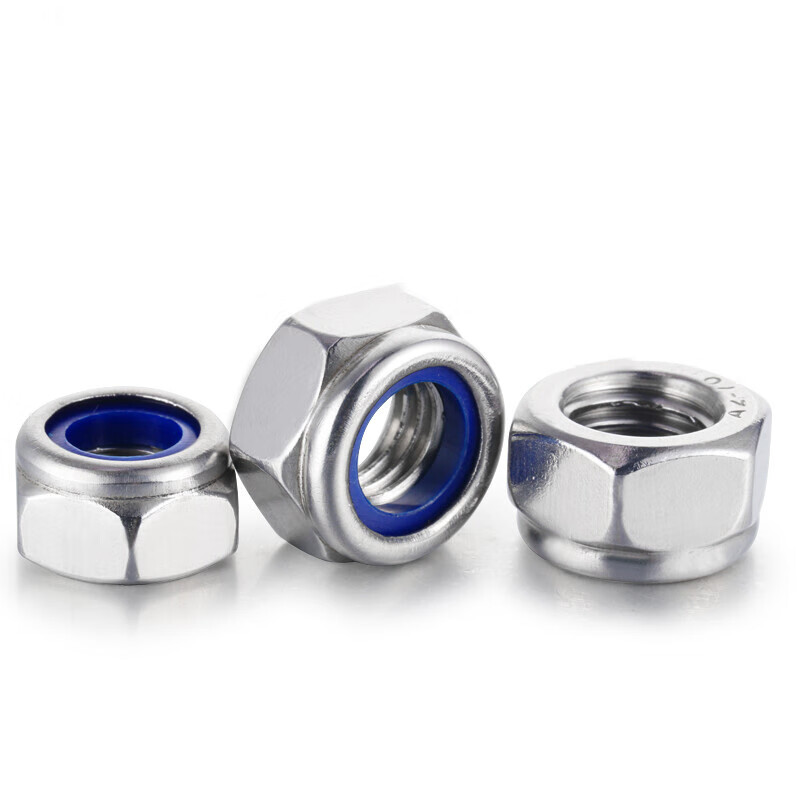
Lock nuts lack this wide flange and resemble standard hex nuts in appearance. Their key feature lies not in their appearance but in their internal structure. Some lock nuts incorporate built-in nylon rings, others use specially shaped threads, and still others feature metal inserts. These hidden structures are designed to prevent loosening, making it difficult to discern their unique features simply by looking at them.

Key Functions
The primary functions of a flanged nut are to distribute pressure and protect the surface. Its flange increases the contact area between the nut and the workpiece, evenly distributing the clamping force over a larger area and preventing excessive localized pressure. At the same time, the serrated flange on a flanged nut allows the serrations to grip the workpiece surface, providing some anti-loosening effect; however, this is merely an additional feature and not its primary purpose. Its main advantage is ease of installation; the built-in flange eliminates the need for additional washers, resulting in higher assembly efficiency.
The primary function of a lock nut is to prevent loosening, specifically addressing the issue of nuts coming loose due to equipment vibration. As we all know, machinery in operation and vehicles in motion generate vibrations. Ordinary nuts can easily loosen on their own under such vibrations, creating safety hazards. Locking nuts, however, feature a special structural design that allows them to remain securely fastened and prevent loosening even in environments with high-frequency vibrations and impacts. Their anti-loosening performance is unmatched by flanged nuts, as they are specifically designed for high-vibration applications.
The working principle of flange nuts is simple: the flange increases the contact area to distribute pressure, while the friction between the threads provides the primary clamping force. Serrated models slightly enhance the anti-loosening effect through mechanical interlocking between the serrations and the workpiece, but their overall anti-loosening capability is limited and cannot withstand long-term high-vibration environments. They are better suited for applications with low vibration and high requirements for protecting the workpiece surface.
The operating principle of lock nuts is more complex and precise. For example, in common nylon insert lock nuts, tightening the bolt compresses the nylon ring, causing it to undergo elastic deformation. This tightly wraps around the bolt threads, generating additional friction to prevent the nut from loosening. All-metal lock nuts, on the other hand, rely on thread deformation to ensure a tight fit between the nut and the bolt, preventing relative slippage even under vibration. Some lock nuts consist of two parts; through an internal wedge-shaped design, they generate lifting tension during vibration, further enhancing the anti-loosening effect and offering a broader range of applications.
Applications

Flange nuts are suitable for applications where strong anti-loosening performance is not required, but protection of the workpiece surface is essential. Examples include fastening in home appliances and furniture, pipe connections, assembly of light-duty equipment, and securing soft materials or precision components. They offer relatively low procurement costs and easy installation, making them suitable for general-purpose applications-particularly those where assembly time needs to be minimized and workpiece surface damage must be avoided.
Lock nuts are suitable for the following scenarios: environments with high-frequency vibration or impact, such as automotive engines, industrial machinery, rail transit, and aerospace equipment. These scenarios demand extremely high anti-loosening performance; if a nut loosens, it could lead to equipment failure or even safety incidents, making the use of lock nuts essential. Although their purchase cost is higher than that of flange nuts, they eliminate the hassle of future maintenance and mitigate safety risks, making them more cost-effective in the long run.
Summary
The key difference between the two is as follows: Flange nuts feature a circular flange, designed primarily to distribute pressure and protect the workpiece. Lock nuts do not have a flange and are primarily designed to prevent loosening and ensure stability.
When selecting fasteners, choose a flange nut if you are concerned about damaging the workpiece surface, want to simplify installation, and the environment has minimal vibration. If the equipment experiences significant vibration and you are concerned about the nut loosening, prioritize a lock nut. Choosing the right nut ensures a safer and more durable connection.
Sanwei Fasteners provides a long-term, stable supply of bolts, nuts, washers, and other fastener products. Please click the button below to obtain detailed product information and a quote.


